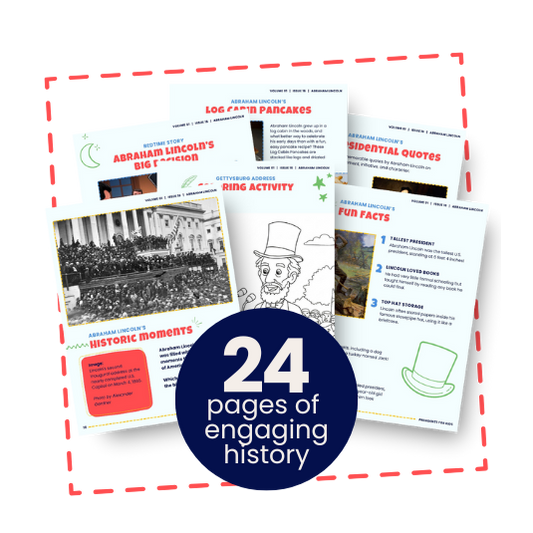
Teaching the US Presidents: A Complete 4-Week Elementary Unit Study
When it comes to teaching the U.S. presidents to elementary students, it’s easy to fall into the trap of names and dates. But asking an eight-year-old to memorize a chronological list of 40+ leaders is a surefire way to induce a nap.
Kids don't connect with numbers; they connect with stories, character traits, and peculiar details. They want to know about the president who kept a pet alligator in the White House, the one who loved jelly beans, and the general who refused to wear a fancy uniform.
By framing the presidency around themes rather than a dry timeline, you can run a highly engaging, screen-free monthly unit study. Here is your complete 4-week scope and sequence to teach the executive branch to your elementary learners.
Week 1: The Trailblazers (The Founders)
Focus: What is a president, and how did the job start?
Before kids can understand individual leaders, they need to realize that the presidency was a completely brand-new invention in 1789. The world was run by kings and queens; a leader chosen by the people was a revolutionary idea.
- The Core Concept: Focus on George Washington and John Adams. Discuss how Washington set the "rules" for the job (like only serving two terms and preferring to be called "Mr. President" instead of "Your Majesty").
- Hands-On Activity: Create a physical "White House Application." Have your child write down the character traits they think a great leader needs (e.g., honesty, bravery, kindness) and "apply" for the job of president.
- The Living Book Recommendation: George Washington's Teeth by Deborah Chandra or George Washington by Ingri and Edgar Parin d'Aulaire.
Week 2: The Map Makers (The Expansionists)
Focus: How the choices of individual presidents grew the country.
This week, show your kids how decisions made in the Oval Office physically changed the map of America.
- The Core Concept: Focus on Thomas Jefferson (The Louisiana Purchase) and James K. Polk (expanding the country to the Pacific Coast). Use this week to tie history directly to geography.
- Hands-On Activity: Pull out a physical map of the United States. Use blue painter's tape or yarn to trace the boundaries of the original 13 colonies. Then, lay down a massive piece of brown packing paper to represent the Louisiana Purchase, showing your kids how Jefferson instantly doubled the size of the country with one signature.
- The Living Book Recommendation: Thomas Jefferson's Feasts by Frank Murphy or The Start of the Trail (Lewis and Clark narratives).
Week 3: The Unifiers (Leading Through Hard Times)
Focus: Courage, resilience, and holding the country together.
Presidents face immense challenges, and this week teaches your children how great leaders act when things get incredibly difficult.
- The Core Concept: Focus on Abraham Lincoln during the Civil War and Franklin D. Roosevelt during the Great Depression and World War II. Discuss how these men used their voices to bring hope to regular citizens.
- Hands-On Activity: To honor FDR's famous "Fireside Chats," turn off all the lights in your living room, build a fort, put a flashlight or fake candle in the middle, and read a historical speech or story aloud together. Talk about how families across the country used to gather around the radio just like this to hear the president give them courage.
- The Living Book Recommendation: Looking at Lincoln by Maira Kalman or A Picture Book of Abraham Lincoln by David A. Adler.
Week 4: The Modern Era (Innovation & Global Leadership)
Focus: Space exploration, modern communication, and breaking barriers.
Bring the study into the 20th and 21st centuries to look at how technology transformed the presidency and how the office became more inclusive.
- The Core Concept: Focus on Dwight D. Eisenhower (starting NASA and the highway system), John F. Kennedy (the space race), and milestone moments like Ronald Reagan nominating the first woman to the Supreme Court.
- Hands-On Activity: Build a "Presidential Code Wheel" or study the secret code of the Interstate Highway System (even numbers go East-West, odd numbers go North-South). Have your child map out a mock road trip across the country using Eisenhower's map code.
- The Living Book Recommendation: The Space Race elementary profiles or Sandra Day O'Connor: The First Woman on the Supreme Court biography layouts.
The 4-Week Unit Study Tracker
To help you track your lessons, here is a simple matrix you can print or copy into your homeschool planner:
| Week | Theme | Key Presidents | Tactile Project |
| Week 1 | The Trailblazers | Washington, Adams | Design a "Help Wanted: President" poster. |
| Week 2 | The Map Makers | Jefferson, Polk | Visual 3D yarn mapping of U.S. expansion. |
| Week 3 | The Unifiers | Lincoln, FDR | Living room "Fireside Chat" read-aloud night. |
| Week 4 | The Modern Era | Eisenhower, JFK, Reagan | Decode highway maps using the even/odd system. |
Summary for Parents: The Power of Anecdotes
The secret weapon of this entire unit is the trivia anchor. Whenever you introduce a new president, find one weird, funny, or humanizing fact about them. Did you know John Quincy Adams went skin-dipping in the Potomac River at 5:00 a.m.? Did you know Andrew Jackson taught his pet parrot how to swear? These small, human details act as memory hooks. Once your child is laughing and interested in the person, they will naturally absorb the big, structural lessons about our government.